Enterprise AI Playbook
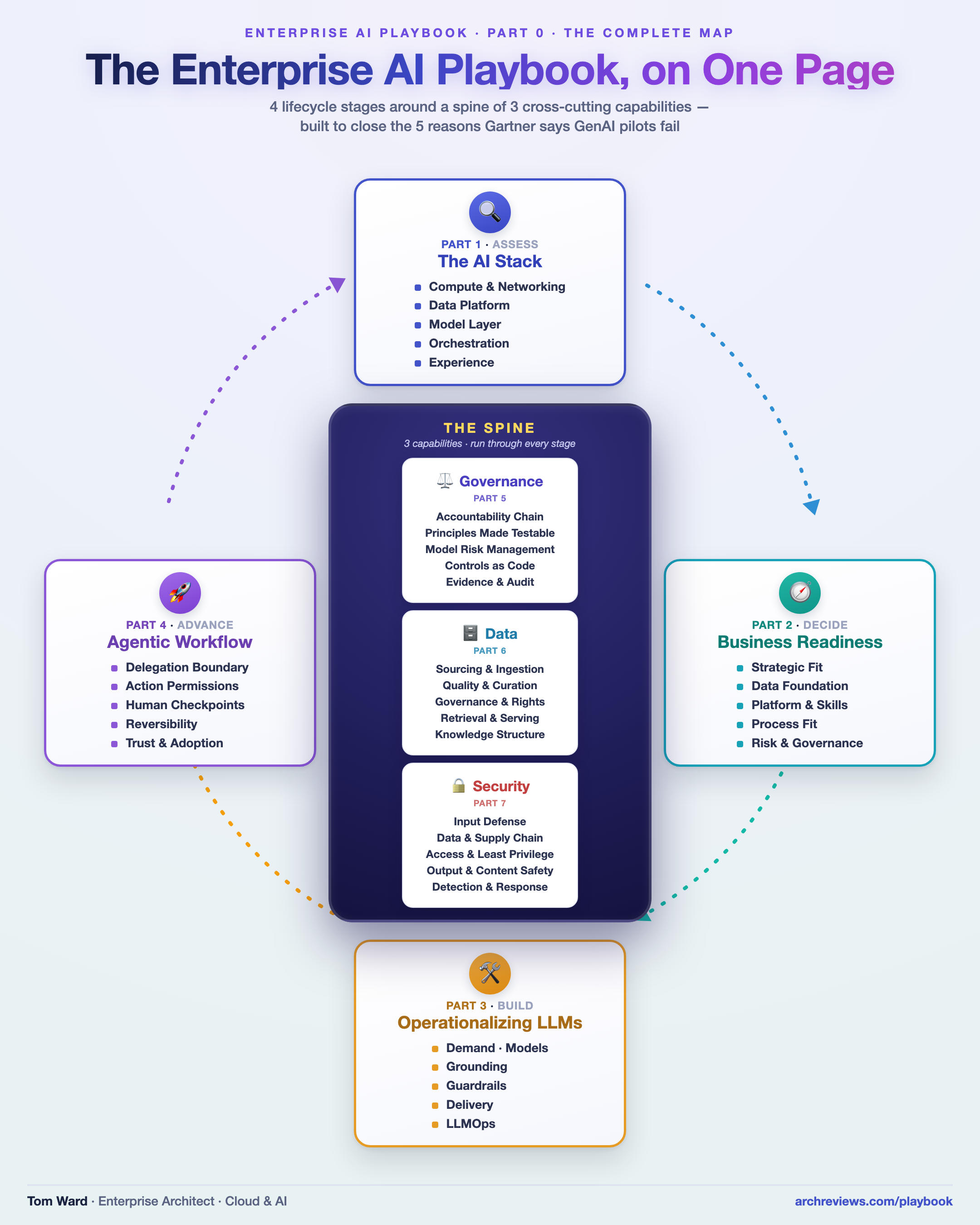
Seven field guides on operationalizing AI in the enterprise — four lifecycle stages (assess, decide, build, advance) around a spine of three cross-cutting capabilities (governance, data, security). Each part ships as an architecture infographic, a deep-dive PDF you can hand to your team, and a checklist — written from twenty-plus years of Fortune 500 platform work, in the same vendor-neutral spirit as the rest of this site.
By Tom Ward, Enterprise Architect — Cloud & AI
- Part 1 of 7 PDF
Assessing the AI Stack from Infrastructure to Interface
Where the playbook starts: a vendor-neutral reference architecture for taking stock of what you actually have. Five layers — compute & networking, data platform, model layer, orchestration, experience — scored on a four-level maturity scale, with security, cost, observability, and portability assessed at every layer. Know what you have, then decide what to build.
Read part 1 - Part 2 of 7 PDF
Aligning AI Initiatives with Business Readiness
A readiness model for matching AI ambition to organizational capacity across five dimensions — strategic fit, data foundation, platform & skills, process fit, and risk & governance — multiplied by the change capacity nobody budgets for. Readiness Gap = Ambition − Capacity.
Read part 2 - Part 3 of 7 PDF
Operationalizing LLMs as Enterprise Tools
A six-layer operating model for taking large language models from promising pilot to governed, production-grade enterprise capability — demand, models, grounding, guardrails, delivery, and LLMOps, with governance as the spine.
Read part 3 - Part 4 of 7 PDF
Leading Agentic AI-Driven Workflow Change
What changes when AI stops suggesting and starts acting. A five-rung autonomy ladder (Assist → Draft → Propose → Supervise → Autonomous) and the five design decisions — delegation, permissions, human checkpoints, reversibility, trust — that must sharpen at each rung, over a human control plane that scales with autonomy.
Read part 4 - Part 5 of 7 PDF
Establishing Ethical, Accountable AI Governance
How to turn AI principles into platform-enforced controls across five pillars — accountability chain, principles made testable, model risk management, controls as code, and evidence & audit — anchored to the NIST AI RMF and mapped to the EU AI Act and ISO/IEC 42001 so regulators recognize the vocabulary.
Read part 5 - Part 6 of 7 PDF
The Data & Knowledge Foundation
A cross-cutting capability, not a lifecycle stage. Five pillars for data that's actually ready to serve AI — sourcing & ingestion, quality & curation, governance & rights, retrieval & serving, and knowledge structure — plus an 8-point AI-ready data test. Poor data quality is Gartner's #2 reason GenAI projects stall; your data is also the one advantage a competitor can't buy.
Read part 6 - Part 7 of 7 PDF
Securing the AI Attack Surface
A cross-cutting capability, not a lifecycle stage. Five pillars for defending enterprise AI end to end — input defense, data & supply chain, access & least privilege, output & content safety, and detection & response — plus a 10-control AI Security Baseline mapped to OWASP's LLM Top 10 and MITRE ATLAS. Prompt injection has no perfect defense; agents that act multiply the blast radius.
Read part 7
Get each part as it ships
One email per release — the infographic, the PDF, and nothing else.
Subscribe